Tube Bending Machine Manufacturer---YONGHENG HYDRAULIC
author: MAY HO
2025-09-15
Tube Bending Machine Manufacturer---YONGHENG HYDRAULIC
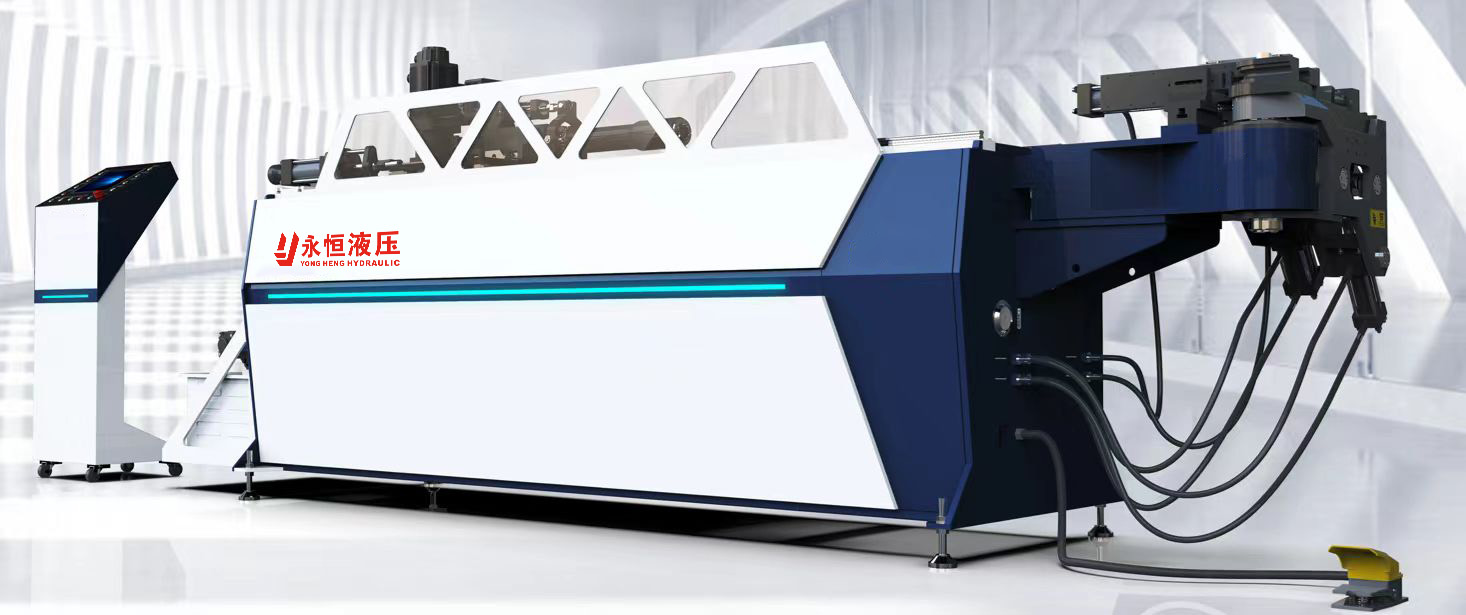
Tube Bending Machine
The primary function of a tube bending machine is to **permanently form metal tubes, pipes, and solid profiles into specific angles and shapes** without compromising the integrity of the workpiece. Its core functions include:
1. **Precise Angle Bending:** It accurately bends a workpiece to a predetermined angle, from a slight 1-degree adjustment to tight 180-degree bends or even full 360-degree coils.
2. **Forming Complex Geometries:** It can create a wide variety of single-plane or multi-plane shapes, such as U-bends, S-shapes, circles, and intricate custom contours needed for assemblies.
3. **Maintaining Cross-Section:** A key function of a good bend is to **minimize deformation**, preventing common defects like ovality (where the round tube becomes egg-shaped), wrinkling on the inner radius, or wall thinning on the outer radius. This is achieved using specialized tooling and techniques.
4. **Processing Diverse Materials:** It can handle various materials, including **carbon steel, stainless steel, aluminum, copper**, and other alloys, each with different requirements for force and tooling.
2. **Forming Complex Geometries:** It can create a wide variety of single-plane or multi-plane shapes, such as U-bends, S-shapes, circles, and intricate custom contours needed for assemblies.
3. **Maintaining Cross-Section:** A key function of a good bend is to **minimize deformation**, preventing common defects like ovality (where the round tube becomes egg-shaped), wrinkling on the inner radius, or wall thinning on the outer radius. This is achieved using specialized tooling and techniques.
4. **Processing Diverse Materials:** It can handle various materials, including **carbon steel, stainless steel, aluminum, copper**, and other alloys, each with different requirements for force and tooling.
---
Tube Bending Machine Manufacturer---YONGHENG HYDRAULIC
### **Characteristics & Features of a Tube Bending Machine**
The characteristics define the machine's capabilities, performance, and level of automation.
1. **Drive System (The source of power):**
* **Manual:** Simple, portable, and low-cost. Ideal for low-volume workshops, soft materials like copper, and maintenance tasks.
* **Hydraulic:** The most common type for industrial use. Provides high power for bending large-diameter and thick-walled tubes. Robust and powerful.
* **Electric/Electro-Mechanical:** Offers high precision, clean operation (no hydraulic oil), energy efficiency, and faster cycle times. Becoming the standard for high-accuracy applications.
* **Pneumatic:** Less common, typically used for smaller tubes or in explosive atmospheres where sparks from electric motors are a hazard.
* **Manual:** Simple, portable, and low-cost. Ideal for low-volume workshops, soft materials like copper, and maintenance tasks.
* **Hydraulic:** The most common type for industrial use. Provides high power for bending large-diameter and thick-walled tubes. Robust and powerful.
* **Electric/Electro-Mechanical:** Offers high precision, clean operation (no hydraulic oil), energy efficiency, and faster cycle times. Becoming the standard for high-accuracy applications.
* **Pneumatic:** Less common, typically used for smaller tubes or in explosive atmospheres where sparks from electric motors are a hazard.
2. **Control System:**
* **CNC (Computer Numerical Control):** The most advanced feature. Allows for programming complex bend sequences with extreme precision and perfect repeatability. Stores hundreds of jobs for future use.
* **NC (Numerical Control):** Offers programmable control but is often less sophisticated than full CNC.
* **Manual Control:** The operator sets stops and controls the bend angle manually for each piece.
* **CNC (Computer Numerical Control):** The most advanced feature. Allows for programming complex bend sequences with extreme precision and perfect repeatability. Stores hundreds of jobs for future use.
* **NC (Numerical Control):** Offers programmable control but is often less sophisticated than full CNC.
* **Manual Control:** The operator sets stops and controls the bend angle manually for each piece.
3. **Bending Method (Defines how the bend is formed):**
* **Rotary Draw Bending:** The most precise method. Uses a die set (a clamp die, pressure die, and a rotating bend die) to draw the tube around the die. Excellent for tight radii and maintaining roundness.
* **Roll Bending:** Uses three rolls to gradually form large arcs and circles (e.g., for hoops, rings, and coils).
* **Compression Bending:** A simpler method where the tube is pressed against a die. More prone to deformation but faster for certain applications.
* **Rotary Draw Bending:** The most precise method. Uses a die set (a clamp die, pressure die, and a rotating bend die) to draw the tube around the die. Excellent for tight radii and maintaining roundness.
* **Roll Bending:** Uses three rolls to gradually form large arcs and circles (e.g., for hoops, rings, and coils).
* **Compression Bending:** A simpler method where the tube is pressed against a die. More prone to deformation but faster for certain applications.
4. **Key Performance Characteristics:**
* **Bending Capacity:** The maximum **tube diameter** (e.g., 2", 50mm) and **wall thickness** (e.g., 4mm) the machine can handle.
* **Minimum Bend Radius:** The tightest radius the machine can form for a given tube size.
* **Accuracy and Repeatability:** The ability to consistently achieve the programmed bend angle and geometry within a tight tolerance (e.g., ±0.1 degrees).
* **Automation:** Features like automatic tool changers, tube loaders/unloaders, and laser checkers for measuring bends in real-time.
* **Bending Capacity:** The maximum **tube diameter** (e.g., 2", 50mm) and **wall thickness** (e.g., 4mm) the machine can handle.
* **Minimum Bend Radius:** The tightest radius the machine can form for a given tube size.
* **Accuracy and Repeatability:** The ability to consistently achieve the programmed bend angle and geometry within a tight tolerance (e.g., ±0.1 degrees).
* **Automation:** Features like automatic tool changers, tube loaders/unloaders, and laser checkers for measuring bends in real-time.
**In summary,** a tube bender's **function** is to create accurate, complex shapes from tubular material, while its **characteristics** (like its drive system, control type, and bending method) determine its power, precision, and suitability for a specific production environment.
Contact:
May Ho
Wechat/what's app:86-139 2728 3041
The Conference Commemorating the 80th Anniversary of the Victory of the Chinese People's War of Resistance against Japanese Aggression and the World Anti-Fascist War
Exhibition Highlights Review | Yongheng Hydraulic at the Russia International Industrial Expo